
CHS grad makes a difference in Africa
By Danny Joseph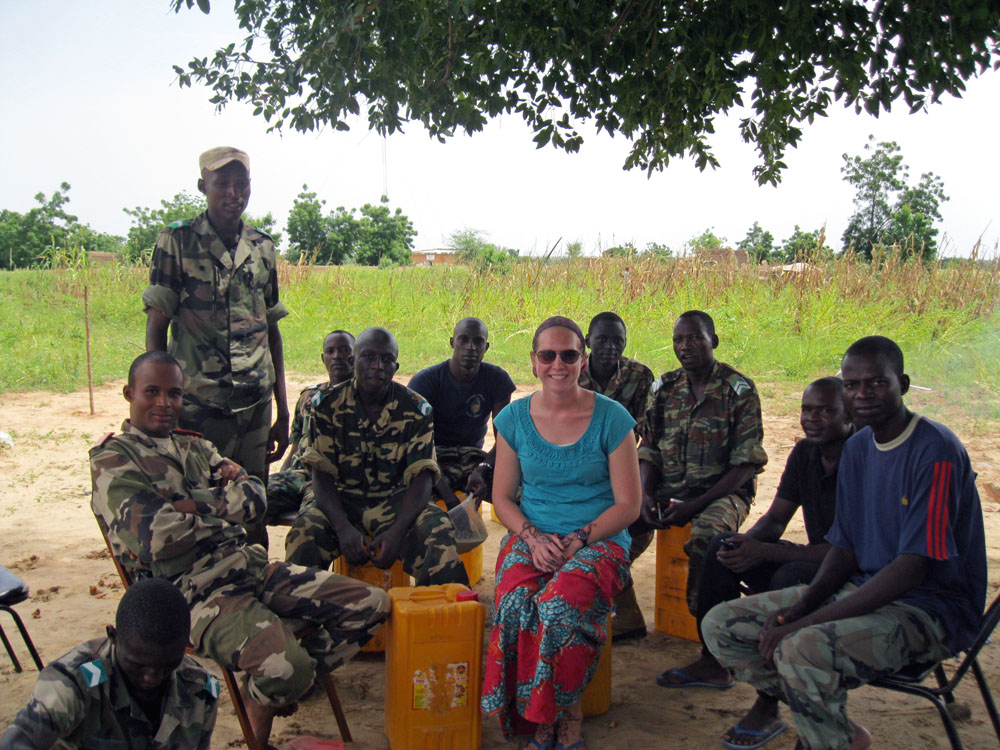
CHS alum Casey McDermott '04 pictured at the mayor’s office in the village of Gabi with Niger military
Violence, poverty, terrorism, and political upheaval are not the average issues confronting a recent college graduate; however, Casey McDermott, a member of Canton High’s graduating class of 2004 and Quinnipiac University’s class of 2008, hasn’t quite chosen an average job.
After spending two years in the AmeriCorps program and also earning a business degree, McDermott decided she wanted to make an impact beyond the borders of the United States. This strong desire to enact social change prompted McDermott to join the Peace Corps, who stationed her in the impoverished West African nation of Niger.
The Peace Corps is a 27-month commitment, including a three-and-a-half-month training period before the volunteers are assigned to a certain village, town, or city. McDermott departed for Niger in July of 2010 and spent her training period in the capital city of Niamey before moving to the village of Gabi. With no running water, electricity, or paved roads, her new home provided a stark contrast to her upbringing in Canton.
“It’s a very impoverished place,” said McDermott. “I slept, cooked, and ate outside every night. The schools and houses are made out of millet stock, and you eat millet every night. There is no meat, except on holidays, when the villagers might slaughter a goat.”
Despite the culture shock, McDermott quickly assumed a leadership role in the community, promoting the Peace Corps values of cultural education, as well as providing technical and medical assistance.
Officially, McDermott was assigned to the corps’ Municipal and Community Development sector and began working in the mayor of Gabi’s office. (Gabi acts as the head of 162 smaller, surrounding communities).
However, McDermott’s impact in the village soon began to be felt on a more tangible, grassroots level. She assisted her host mother at her job in the village’s maternity ward, and then began serving as the second-year English instructor for secondary students in the village.
Using a solar-powered computer, McDermott taught her classes how to use Microsoft Word and Excel, and also familiarized them with the basics of the English language. Although the official language of Niger is French, the villagers of Gabi speak a dialect called Hausa. Casey, or Hadjara, as she was known to her students and fellow villagers, had to first pass a Hausa proficiency test before her placement in the village, a common requirement for Peace Corps volunteers.
As she was tackling the language barrier, McDermott also sought to reverse the stigma that surrounded female students. The heavily conservative, Islamic culture of Gabi dictated that classes — which consisted of as many as 50 students — contained at most eight or nine females.
“Female education was a very important issue in our work there,” McDermott remarked.
McDermott saw athletics as another medium for social progress. She raised funds for the construction of a basketball court in the village, and drawing on her experiences as a guard for the CHS team and as a volunteer coach for the CRBA, became the coach for a de facto girls’ basketball team.
Unfortunately, just as she began to solidify herself as an agent for change and progress in the community, McDermott’s time in Gabi was disrupted by violence.
The AQIM, a branch of Al Qaeda that operates in West Africa, is widely viewed as the responsible party for a recent string of kidnappings of foreigners in Niger. Most recently, two French nationals were kidnapped from a bar, located a short distance from McDermott’s Peace Corps headquarters. One of the men, an aid worker, was scheduled to be married the next day. His companion had traveled to Niger to take part in the ceremony.
“The AQIM hires outside kidnappers – they just entered this bar and grabbed the first two foreigners they saw,” said McDermott.
A high-speed pursuit followed, culminating in a shootout near the Mali border between the kidnappers, the French military, and the Niger military. The firefight resulted in the deaths of the two French nationals as well as the kidnappers.
While the previous kidnappings occurred in the north of the country, away from the posts of Peace Corps volunteers, the proximity of the latest act of violence to their base of operations forced the Peace Corps administrators to act suddenly and decisively. Thirty volunteers were told to pack their bags and were immediately flown on a UN World Food Program plane back to Niamey, where they were briefed on what would happen next.
“A Peace Corps van took us to our village, where we had an hour to pack everything up and say goodbye,” McDermott recalled. “The next day we flew back to Morocco, and then we flew to Cairo, Egypt, on the last Wednesday in January.”
McDermott and several friends then flew to Dahab, a city located on the opposite side of the Gulf of Suez. Little did she know how fortuitous their vacation destination would become. Cairo soon became the epicenter for political unrest and protests against longtime Egyptian president Hosni Mubarak. As violence gripped much of the country, Dahab resembled something of a safe haven for McDermott and other foreigners.
“A lot of Egyptian people on that side of the canal supported Mubarak,” said McDermott. “We were in a tourist area with a lot of Americans and Australians.”
Convincing her parents that everything was copacetic proved to be a bigger challenge for McDermott than avoiding the protests.
“The government shut down the internet and cell phones, so it was really hard to get a hold of my parents,” said McDermott. “When I did reach them, they weren’t happy about [me being in danger], but I assured them I was a plane ride away from the violence.
“We then flew out of Cairo on the first Wednesday in February, the night the violence really escalated.”
McDermott also experienced loss on a much more personal level during her time in West Africa. A 25-year-old corps volunteer whom McDermott had trained with in Niamey was found dead ten days after being assigned to her post. No physical harm was done to her body, which was discovered under her bug net. The case remains under investigation, but no conclusive results have been found.
In the face of tragedy, turmoil, and conflict, McDermott remains steadfast in her commitment to the Peace Corps and its message of helping people. McDermott will return to Africa in June as a Small Enterprise Development volunteer in Senegal.
“I think people who are interested definitely should do it,” said McDermott. “I have re-enrolled and I am not giving up on my two-year commitment. The Peace Corps gives you the freedom to implement projects for change and do exactly what you need to do.”
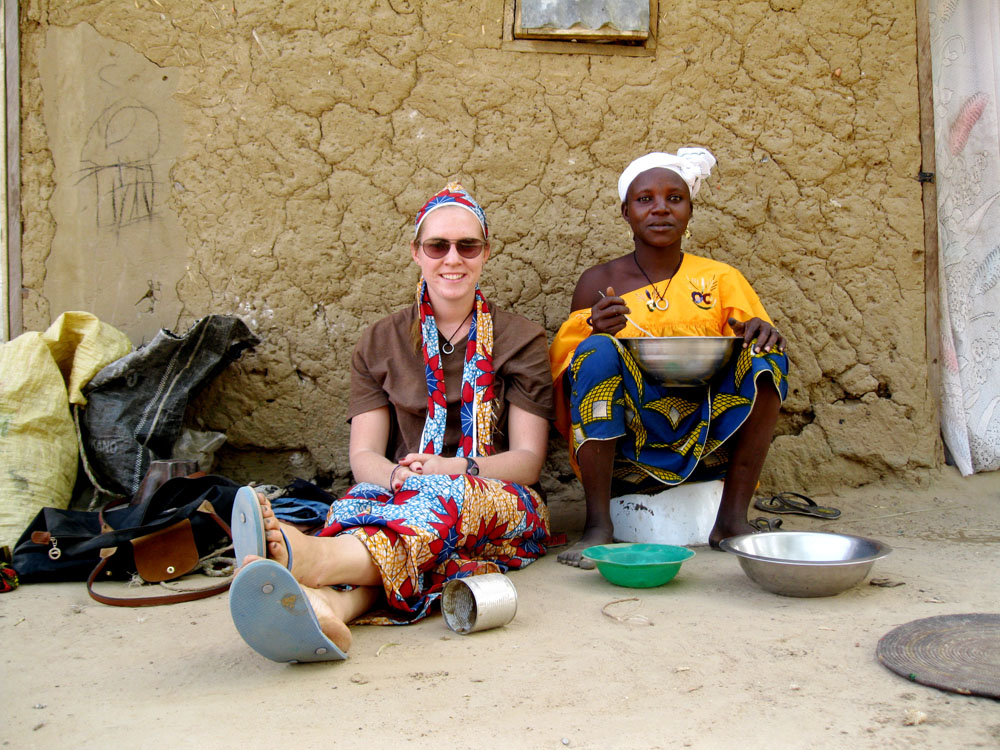
McDermott with her host mom, Assama
Short URL: https://www.thecantoncitizen.com/?p=3432


 Posted by Danny Joseph
on Mar 3 2011. Filed under Features.
Both comments and pings are currently closed.
Posted by Danny Joseph
on Mar 3 2011. Filed under Features.
Both comments and pings are currently closed.