
True Tales from Canton’s Past: A Kiss on the Cheek
By George T. ComeauThe editor of this paper once asked me if I ever thought I might run out of subjects to write about in this column. The question really never occurred to me, owing to the fact that our history dates back more than 350 years. Add to that the pre-contact period of our native culture, and then pile on thousands of years of archaeological evidence in the Neponset Valley, there are hundreds of stories that are yet to be told.
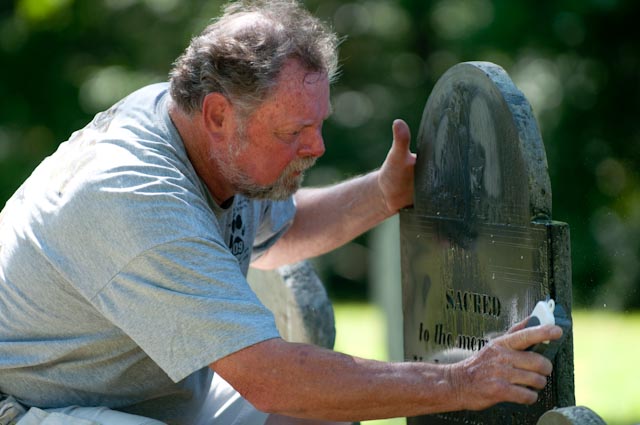
Johnny Jorgenson cleaned over 100 gravestones at the Canton Corner Cemetery this past year. (Courtesy of the author)
As often is the case, this is the time of year to take stock of the past and look forward to the future. In my case, I look over the stories I have researched and know that there is a developing body of historical work that grows as a result of this newspaper’s commitment to Canton. Moreover, there is so much interest in Canton’s history evidenced by the passing of the Community Preservation Act that it leads me to conclude that 2013 was a pretty good year.
Often, I share the fact that many of the stories that are written are as new to me as they are to you — perhaps a nugget has been passed along and I’ll research the rest of the back story. Often times I will receive email or even snail mail encouraging me to write about a heroic relative or an ancient house. You, the reader, send me on sleuthing missions, which I happily suss out on weekend forays to the Historical Society.
This was the year that I met Joseph Henry Hatfield, the fairly famous artist and developer of “Hatfield’s Colors.” Hatfield came to life as a painter of children and one of Canton’s more industrious entrepreneurs of the early 20th century. I was also welcomed into the historic “barn” home of Liz and George Parker, who left me a beautiful message after I wrote of their amazing recycled home built by Fosdick Harrison. As I passed my hand over the balustrade in their home, I shared the love of the space and felt the spirit of two amazing families that have lovingly preserved one of Canton’s great homes.
In February, I came to know Thomas Casey, who placed all his bets on an illegal bookie establishment. In my mind’s eye, I stood on Washington Street as the State Police broke down the doors with axes and hauled Casey and his customers off to jail. I could smell the wood splinter and hear the cheers of the crowd as some of Canton’s best workingmen were upended by their wives for spending hard-earned money in that betting parlor.
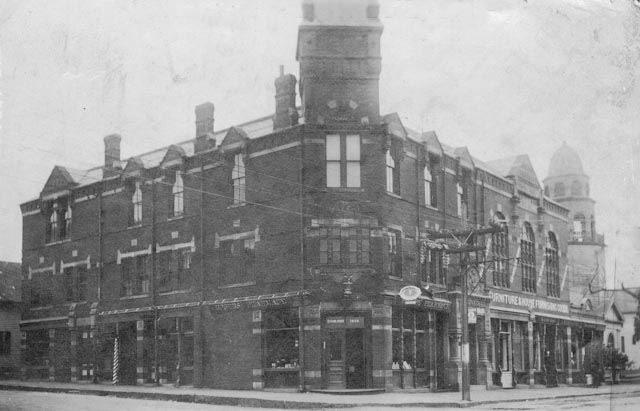
Oddfellow’s Hall in Canton Center where Thomas Casey ran an illegal gambling parlor (Courtesy of the Canton Historical Society)
This was also the year that I sat writing in my kitchen about the heroic sea captain Harold Winslow. As my fingers flew across the keyboard, I was with him as he rowed out in icy December waters to save men from a sinking schooner off the shores of Newfoundland. Winslow, a true hero from Canton, was responsible for safely returning these sailors to their families so that they might live to see their children’s faces on Christmas morning. In one of the hardest stories to tell, I wrote how Winslow, at age 45, crippled with pain from cancer, sat in his kitchen and committed suicide. Not leaving the story there, we boarded a cruise ship along with Winslow’s best friend. Together the reader and I were on the bridge the night Canton’s heroic sea captain’s ashes were laid to rest through a burial at sea. The starlit night, the soft breeze, and we were hundreds of miles away with Canton’s history.
This was also the year we were wrapped up in Canton’s most historic quilt. The Martha Howard Quilt preserved at great cost to the Canton Historical Society went on display for hundreds to see at the Rhododendron Quilting Society’s annual meeting. If not for the work of Marie Gibbs, our historic textiles would still be reconciled to musty old trunks in the basement of the Historical Society. In the coming year, Gibbs hopes to secure funding for another quilt preservation project through CPA funds, and another story will be born here on the pages of the Canton Citizen.
It was also a difficult story to share when we were brought back to 1913 to recall firsthand accounts of the dozens of deaths brought on by one of America’s worst outbreaks of strep throat sourced by a tainted milk supply. Hundreds fell ill and the town was crippled for months as a result of this outbreak. Still studied today, it was a little known part of our history to just about everyone in town.
As was the amazing balloon race won by H.H. Clayton in 1907. Together, the reader was placed in the wicker basket with Clayton as we soared high above the landscape. “There was no provision for sleep, but we ate our three regular meals in the air just as if we had been on the ground,” recalled Clayton. “There was no dressing for breakfast, or dinner, except for exchange of our shoes for slippers, and to remove wraps, as the temperature demanded. For food we carried such provisions as rolls, muttonchops, mutton stew, fried chicken, eggs, crackers, and sausage. For drinks we carried some dozen or so bottles of Apollinaris water, a bottle of coffee, a bottle of tea, and two or three bottles of wine.” It was an extraordinary story that featured a pioneer in American meteorology and aviation.
Just weeks ago, I was invited to speak at the re-dedication of the World War I monument. It was through a friendship with Canton’s James Homans that I was able to write about his ancestor, Helen Homans, the only Canton woman to die in service in the Great War. To this day, as a result of that story I get email and photographs of that brave Canton woman tending to the sick, dying and deformed soldiers of the trench.
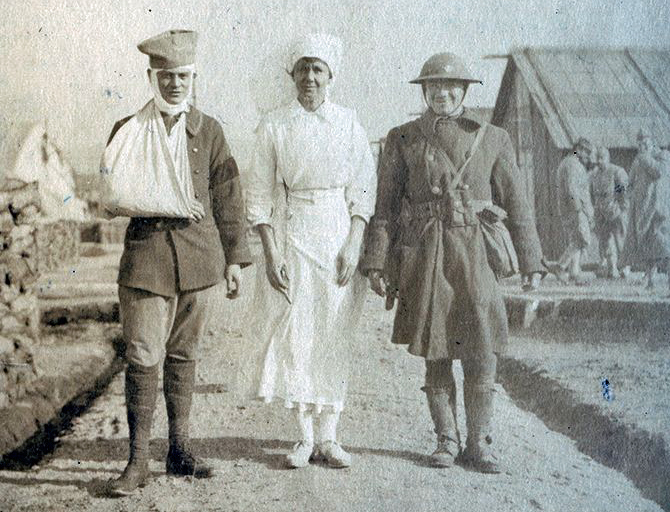
Helen Homans in Vesseny, France, during World War I (McLennan Collection at the Cape Breton Regional Library)
If there is one story that will touch me for the rest of my life, it will be that of Helen Homans. My words could never express the commitment and sacrifice that she gave to France and America in her duty to mankind. Recently, when visiting the Council on Aging Women’s Club, it was hard to get through the story, simply because she was one of the most beautiful women who touched the essence of goodness to mankind. Canton should be proud of Helen Homans.
Some stories, as a result of being written, take on a life beyond the initial publication. That is the case with the tale of William McKendry, another sea captain who was chosen as a subject as a result of a letter for sale on eBay. After that story was written, a comment on the Citizen website led me on the track of Gene Slavin. It turns out that Slavin had bought a parcel of McKendry letters many years ago.
“I will tell you about this, I acquired these letters about 40 years ago, read them and thought this is something that I would like to work on in my retirement, so I put them in a closet and there they sat,” said Slavin. “I have been retired now for 20 years, so I thought that I had better do something with them. My wife and I are now typing them up so they can be read better. I hope to have them ready by spring. The earliest I have is April 1860 when William McKendry was a captain of a merchant ship in Calcutta, India, and told of the bad conditions there and how he misses his wife and son. Other letters start when he was on the USS Winona and of his experiences on board.” Each week, I get to read the Slavin transcripts, and soon you too will be back aboard great ships in far off places at the side of Captain McKendry as he pines for his home in Ponkapoag.
The ocean was a strong theme for me this year as I also told the story of Commodore Downes, an illustrious hero of the War of 1812. For some reason, Canton’s connection with the sea is a strong storyline that recurs through our history. As one of the highest-ranking naval officers in American history, we celebrated his service to our country.
And yet there are modern historical heroes that are celebrated here in these pages. The work of Johnny Jorgenson brought a flood of email to both his home and mine as he tirelessly cleaned the graves at Canton Corner Cemetery. Another CPA grant may very well accelerate that project, bringing a closer appreciation to one of our most historic and oldest cemeteries in the United States.
There were ghost stories, and well-read diaries, revolutionary war battles, and love stories that crossed the pages. In all there were 24 tales from Canton’s history that brought us closer to our place. Perhaps my favorite story, however, was the writing of Lucy Ronayne’s amazing life in our town. Spending an evening with Lucy and her daughter was an experience that brought me closer to why this place is so terrific. And on my birthday this year, Lucy saw me and sang to me and finished with a soft kiss on my cheek. That is what makes Canton’s history come to life and at times brings a tear to my eye. Thank you for a terrific year of Tales from Canton’s Past.
Short URL: https://www.thecantoncitizen.com/?p=23576


 Posted by George T. Comeau
on Jan 1 2014. Filed under Canton History, Features.
Both comments and pings are currently closed.
Posted by George T. Comeau
on Jan 1 2014. Filed under Canton History, Features.
Both comments and pings are currently closed.