
Governor’s working group outlines options for Canton-based Pappas Rehabilitation Hospital
By Jay Turner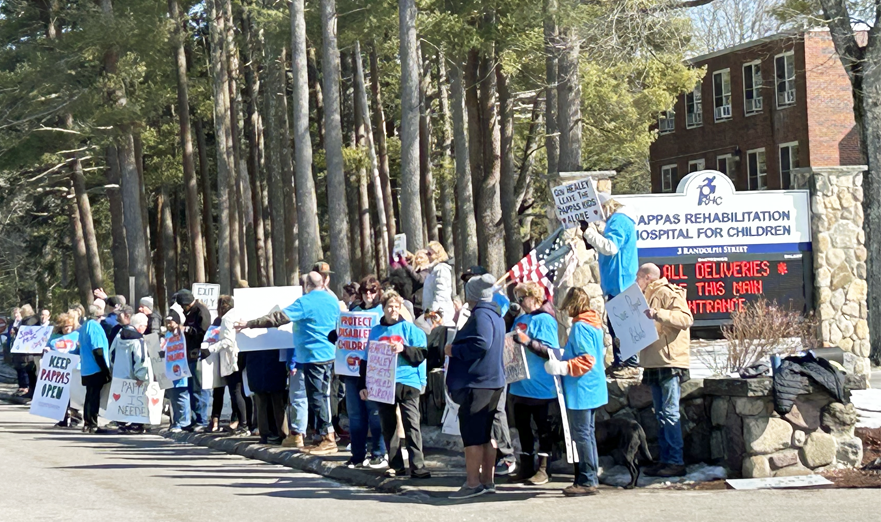
Pappas Rehab Hospital supporters demonstrate outside the facility last winter.
This story originally appeared in the October 30 edition of the Citizen.
There is a path forward for the state-run Pappas Rehabilitation Hospital for Children to continue meeting the needs of severely disabled children on its Canton campus over the long term, but it’s not a quick fix and is not going to come cheap.
That was one of several key takeaways from a sobering new report prepared by the Pappas Working Group, a 24-member team of stakeholders appointed by Governor Maura Healey to review the pediatric care currently offered at Pappas and assess various options for the facility moving forward.
Originally targeted for closure as part of the governor’s FY26 state budget proposal, Pappas was later granted a reprieve after Healey heard directly from patients, families and staff, prompting her to institute a formal pause on plans to relocate patients to Western Mass. Hospital in Westfield. During subsequent budget debates, state lawmakers voted to fully fund Pappas through the end of the current fiscal year, and in a separate amendment filed by Rep. Bill Galvin of Canton, they agreed to establish a special legislative commission to examine future options for the facility.
Having completed its own assessment, the governor’s working group has voiced its support for the legislative commission and said it “stands ready to conduct a knowledge transfer” as the group begins its work.
As for its own findings, the working group, which was co-chaired by Canton Town Administrator Charles Doody, opened its report by acknowledging the “significant unmet needs” of children in the commonwealth with complex medical challenges, as well as the “extremely limited” options available for rehabilitative hospitalization.
As it stands, the 120-year-old hospital school, which is located off Randolph Street on a sprawling, 166-acre campus, is the only facility in the state’s public hospital system with pediatric beds. However, in its current physical condition, which the report characterized as “antiquated and deteriorating,” it remains severely limited in the patients it can serve.
The report cites a 2023 study by the state Division of Capital Asset Management and Maintenance which found deficiencies in program and design, exterior conditions, HVAC, building infrastructure and envelopes, and accessibility. The study resulted in the closure of two residential buildings on campus, and since that time, the remaining residential building has experienced a HVAC system failure and significant basement flooding.
“While DPH believes the patients are being safely cared for at the current time, the services at PRHC rest on a fragile infrastructural foundation,” stated the report, adding that Pappas leadership, despite its best efforts, “does not trust the situation to remain stable for its patients into the near future.”
To continue providing pediatric care at PRHS, the working group considered four options, in addition to the option of closing the Canton campus and ending hospital, school and vendor operations on site.
The most ambitious option calls for a “reimagining” of the Pappas campus as a “center of excellence for the care and development of children with medical complexity,” complete with a new, 56-bed long-term care hospital, a new elementary/secondary school, new athletic/aquatic facilities, new group homes for patients transitioning into adulthood, and extensive renovations of existing amenities. While the long-term benefits would be substantial, the report cautions that it would involve a “major, site-wide construction project” that would necessitate the closure of the campus for five-plus years with projected costs exceeding $440 million.
Option two calls for many of the same upgrades, but they would be done in phases over a period of 10 or more years, enabling Pappas to maintain its existing services while the work progresses. Total costs would be slightly higher than option one, and there would be disruptions for patients and staff to navigate over an extended period of time.
Option three involves making only moderate investments to ensure life safety, quality, and regulatory standards while otherwise maintaining the “status quo.” While far more affordable and a lot less disruptive, the working group stated plainly that this would not be a “sustainable solution,” as systems will eventually fail and the same admissions constraints would apply, limiting delivery of care to a narrow set of patients.
The fourth option would be to convert the campus from a long-term care hospital to a residential school serving children with disabilities. The same moderate investments identified in option three would be needed, but there would be a significant loss of federal reimbursement as well as a reduction in staff to match the lower level of care.
Also receiving low marks was the option of closing the facility altogether — a move that would result in the elimination of already scarce pediatric beds, the loss of educational and therapeutic services, and the elimination of jobs for several “talented and hardworking” professionals. In this scenario, according to the working group, a “re-development planning exercise” would be launched by the commonwealth to determine future uses for the site.
The working group also assessed the proposal originally contemplated by DPH as part of the planned closure of Pappas, which involves the creation of a new, 21-bed pediatric unit at Western Mass. Hospital. They determined that it could be achieved with only moderate effort and would be both “financially efficient and well supported by campus infrastructure.” However, they did not consider it as a replacement for Pappas but rather as a supplement to the pediatric beds offered at the Canton campus.
Another option considered by the working group was a partial sale of PRHC property to help offset the costs of needed improvements, although they noted that the potential revenue gain would be “orders of magnitude insufficient” to offset the capital costs being contemplated. The group also did some preliminary investigation into public/private partnerships, such as a land sale agreement in which the developer makes the capital improvements and then leases the property back to the state. Having gained a deeper understanding of the commonwealth’s capital constraints, the working group agreed that there could be potential with such a partnership and that “more investigations are warranted.”
Although the working group did not seem to indicate a preference for closing Pappas, a recent demonstration held outside the facility suggests there is still widespread skepticism among staff regarding the state’s true intentions.
“We continue to discharge our patients to residential schools or other hospitals that cannot provide the same level of care our patients receive at Pappas but have not admitted patients at the same rate in the past six months,” noted Michelle Sweeney, Pappas’ Supervisor of Physical Therapy. “The clinical staff have approved multiple admissions, but we have been blocked from admitting these patients to our care for one reason or another.”
Staff members worry that these efforts are merely a precursor to what they view as the administration’s “ultimate aim,” which is to quietly dismantle the facility before efforts to preserve it can take hold.
“Since hearing of the potential closure of Pappas, we continue in our quest to save this specialized facility,” stated AFSCME 1517 President Nancy Silva. “Pappas is a community, a place where children with unique medical, emotional, and social needs can receive care tailored specifically for them … We are calling for investment in public health, not just at Pappas but across the state, to ensure continued access to quality care for Massachusetts’ most vulnerable residents.”
Short URL: https://www.thecantoncitizen.com/?p=132723


 Posted by Jay Turner
on Nov 13 2025. Filed under News, Schools.
Both comments and pings are currently closed.
Posted by Jay Turner
on Nov 13 2025. Filed under News, Schools.
Both comments and pings are currently closed.