
Paul Revere Heritage Site Evolution Pt. 1
By Guest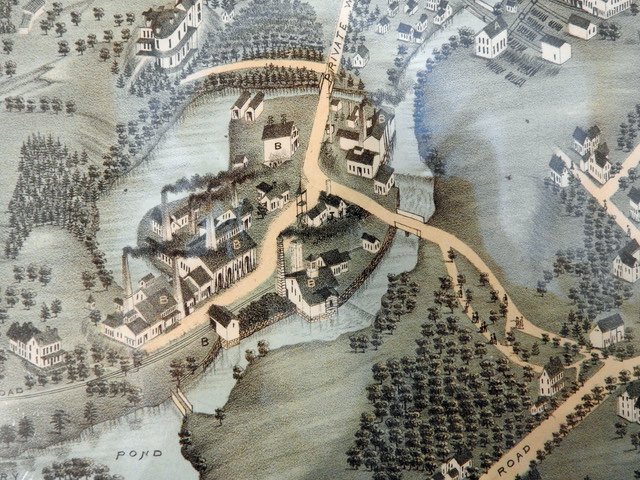
A view of Canton, Massachusetts circa 1878, concentrating on the Heritage Site area
By Rich Trotto
The Paul Revere Heritage Site in Canton preserves history with roots going back to the creation of our country. When I heard that Paul Revere had a summer home in Canton where he expanded his businesses starting in 1801, it raised my eyebrows! Over the years it expanded into a large industrial site, notably by the Plymouth Rubber Company starting in the early 1900s. The entire area was purchased, and I believe it was called the Plymouth Rubber Redevelopment Project when town officials/historians entered into an agreement with the developer to utilize 2.5 acres to preserve the Revere Copper Rolling Mill and Revere Draft Horse Barn — now housing the Northern Spy restaurant and newly opened Museum of Discovery & Innovation — plus seven more acres for the park. Bernie Plante of Canton Holdings LLC (the developer) gave me permission to enter the work site to take pictures. I started doing so on May 4, 2015, and the photos are the foundation for this series of Paul Revere Heritage Site articles.
The inexpensive Kodak Brownie camera popularized photography in 1900. For a glimpse into Paul Revere’s time, we rely on formal paintings, drawings, printing presses and the written word. I use these resources — many from the collections of the Canton Historical Society — to tie my photos into the history of the site and the nation. The above photo is one-fourth of the horizontal width of a kitchen-table-sized 3D map drawing, titled “View of Canton, Mass 1878,” concentrating on the Heritage Site area. Let’s discuss this initial photo, but note that additional details will be presented in future installments:
Factory Pond extends below the bottom left corner. Below that is where the Boston & Providence Railroad passes over the Viaduct. The Canton River (East Branch of the Neponset River) feeds Factory Pond, and its power-generating potential is what brought Paul Revere to the site. Not only did the river supply power, but it “washed away” pollutants.
Just to the left of the bottom half of the Canton River is the railroad spur line, which was then called the Revere Copper Co.’s Railroad. Paul Revere and later the Plymouth Rubber Co. used the tracks to transport raw materials and finished products to and from the Canton Junction Railroad Station. Below the smokestack smoke is the copper rolling mill, among the many other newer structures that were removed during the development process. The smoke is “touching” the stand-alone draft horse barn that was moved a short distance closer to the mill during restoration.
In the center of the photo at the road intersection can be seen Revere’s summer home with his bell tower extending across the road. Happily, that survived long enough to be photographed! At the top center of the photo where the letter “P” is in “Private Way” is where the guard shack was located and where construction equipment entered the work site (and where I parked to take photos starting in 2015). This drawing predates Revere Street, which passes immediately to the left of the leftmost pond. Private Way is currently a lefthand branch just before the current Canton Fire Station, and houses there have Revere Street addresses!
In the bottom right corner of the photo is Railroad Street, which passes under the viaduct. It is now called Neponset Street, and the site’s current diversion channel was later directed beside that road around the Revere Heritage Site.
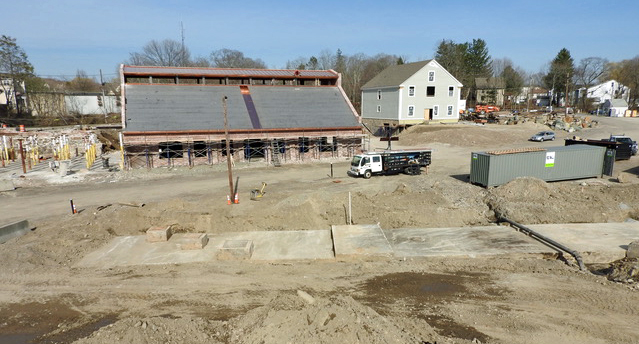
As the industrial site evolved, power was generated by waterpower and then coal-fired steam and electricity. When waterpower was no longer required, the Canton River was moved underground through a triple box culvert. After the Canton River overflowed its banks on multiple occasions, the river was directed underground through the culvert, and excess flow was directed around the current site along the diversion channel.
On April 11, 2017, during site development, the triple box culvert was exposed for inspection. In the photo below, you can see where the river passes underground next to the mill and barn:
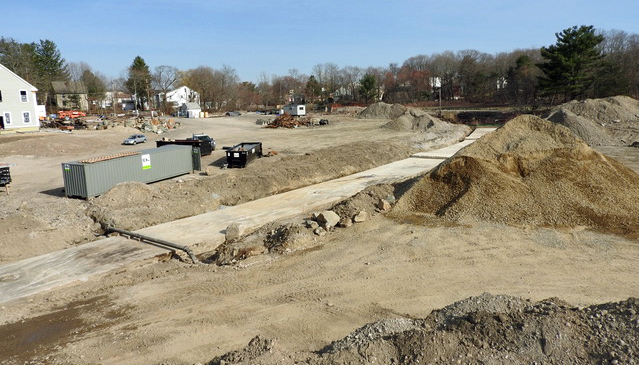
In this next photo, you can see where the triple box culvert passes upstream toward the dams where the diversion channel begins:
More topics to come in future installments — save them for cross referencing.
**Click here for Part 2 of the series**
Rich Trotto is a longtime resident of Canton and a frequent contributor to the Citizen.
Short URL: https://www.thecantoncitizen.com/?p=133879


 Posted by Guest
on Apr 24 2026. Filed under Canton History, Featured Content.
Both comments and pings are currently closed.
Posted by Guest
on Apr 24 2026. Filed under Canton History, Featured Content.
Both comments and pings are currently closed.