
Neponset earns mixed grades on annual report card
By Jay TurnerWater quality grades are out for the Neponset River and its tributaries, and the results are somewhat mixed, with the bulk of sites tested earning an overall grade of B or better but nearly half of them falling below that mark for compliance with swimming standards.
Part of a joint reporting effort between the Neponset, Charles, and Mystic river watershed associations, the annual Water Quality Report Card assigns letter grades to assess the rivers’ health from a recreational perspective and to educate the public about challenges to water quality.
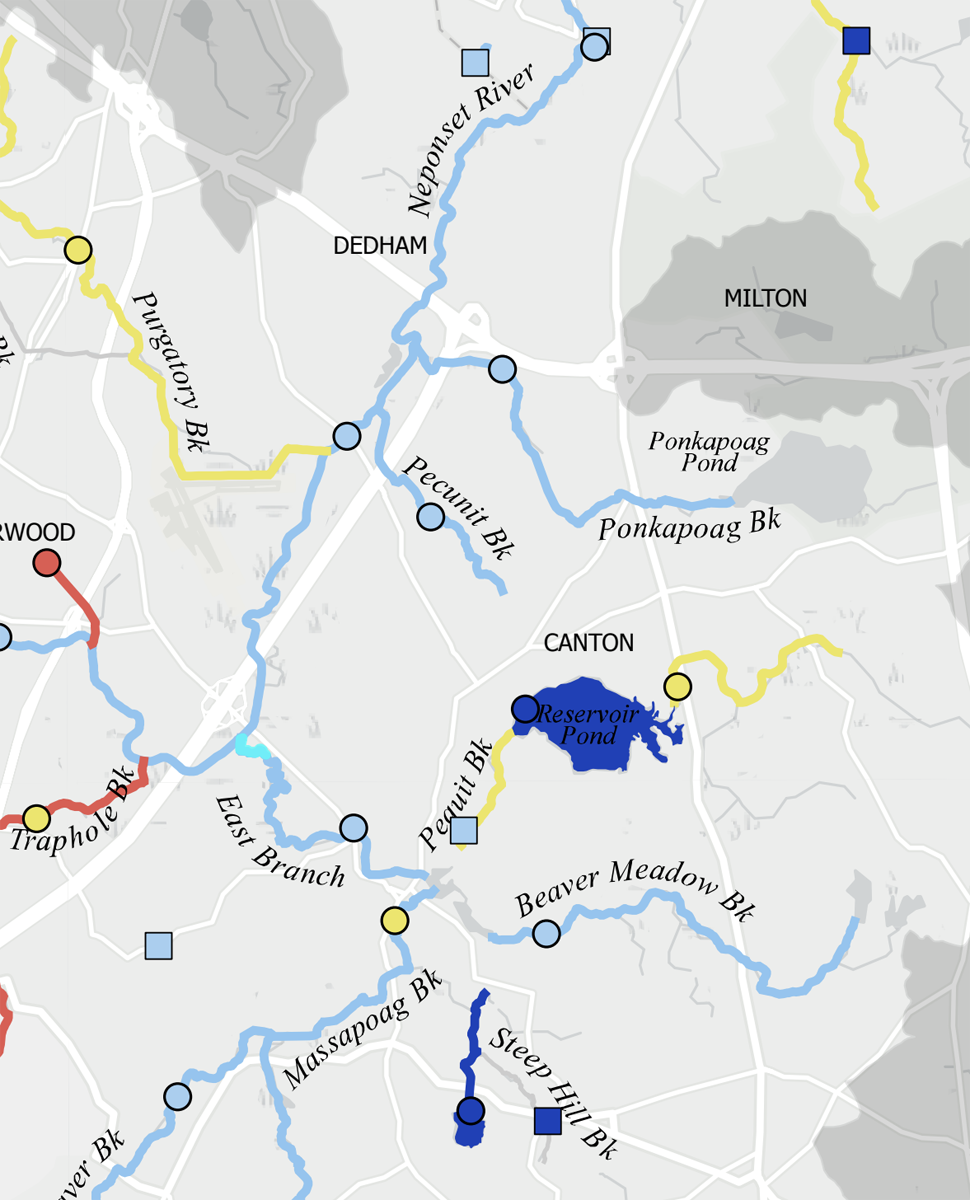
The waterbodies tested in Canton received a mix of B and C grades. (Click image to enlarge)
This year’s report card was formally announced at an event held May 6 at the Boston Museum of Science, where representatives from the three watershed associations, the U.S. Environmental Protection Agency (EPA), and Mass. Executive Office of Energy and Environmental Affairs reflected on the successes, challenges, and ongoing efforts to restore water quality across all three river systems.
Speakers focused specifically on how increased precipitation and outdated infrastructure impact river health, safe recreation, and enjoyment of these rivers, and how close cooperation at the local, state, and federal levels is necessary to advance on-the-ground solutions.
Grades are based on the percentage of time that water bodies were considered suitable for boating and/or swimming over the past three years, as determined by the level of bacterial concentrations — namely E. coli — that is found in samples taken through NepRWA’s Community Water Monitoring Network, X-Cel Conservation Corp., and Mass. Water Resources Authority (MWRA).
An A grade means that the site is swimmable almost all of the time; a B means it’s swimmable most of the time and almost always boatable; a C means it’s usually boatable but generally not swimmable; a D means it’s sometimes boatable but not swimmable; and an F means that it usually does not meet boating or swimming standards.
For the Neponset Watershed, grades in the mainstem maintained a B, while tributaries ranged from a perfect score (A+) at a few different sites down to a low F for the watershed’s biggest trouble spot — Norwood’s Meadow Brook, which feeds directly into the Neponset and is less than 1.5 miles from the Canton border.
Besides Meadow Brook, the only other testing site to score below a C was Traphole Brook on the border between Walpole and Norwood.
Notably, of the 10 ponds monitored, nine received a grade in the A range, including Canton’s Reservoir Pond, which met both boating and swimming standards nearly 89 percent of the time. The lone exception was Sprague Pond on the Boston/Dedham border, which saw its combined grade decline significantly from A+ to B-.
The town of Canton, meanwhile, nearly made the “honor roll” this year with a B grade or better at seven of its eight testing sites. Both the middle portion of the Neponset mainstem, which spans nearly the entire length of Canton’s western boundary, as well as the East Branch of the Neponset, which travels through Canton Center and the Paul Revere Heritage Site, saw slight declines from A- to B+, while testing sites at Massapoag Brook (near Walnut Street) and Ponkapoag Brook (near Elm Street) maintained grades of B+ and B, respectively.
A few other Canton sites were able to gain some ground this year, with Beaver Meadow Brook (near Pine Street) improving from a B to a B+ and Pecunit Brook (Elm Street) rising from a C to a B-.
The only Canton site to earn an overall grade below a B was Pequit Brook (near Del Pond Drive), which earned a C grade for the second year in a row but managed to improve its overall compliance score by nearly 5 percentage points.
When looking solely at swimming grades, a number of sites across the watershed did not fare so well, including the East Branch (C+), Ponkapoag Brook (C-), Pecunit Brook (C-), and Pequit Brook (D), although none of these sites have historically been used for that purpose.
“Overall, the separate scores for boating and swimming provide a clear picture: the Neponset is overwhelmingly safe for its most common form of recreation — paddling,” noted NepRWA Executive Director Ian Cooke. “While improvements to infrastructure, stormwater management, and equitable access remain top-priority goals, residents can feel confident boating on the Neponset without major concerns for their health.”
At the same time, Cooke and his colleagues cautioned that increases in extreme weather, as seen in recent years with contrasting periods of heavy rainfall and severe drought, can have significant impacts on water quality and could threaten to reverse some of the gains that have been made toward achieving swimmable urban rivers.
One of the primary consequences of this kind of severe weather is increased stormwater pollution — rainwater contaminated with gasoline, oil, pet waste, and parking lot debris that is carried by storm drains into rivers and streams. The result, according to local environmental leaders, is “rampant growth of invasive plants, toxic cyanobacterial blooms, and even fish kills.”
Despite these and other pollution challenges associated with outdated infrastructure, the three area watershed associations, in announcing the latest water quality grades, offered up a “shared vision for a resilient future.”
“It’s not that we lack resources; it’s that we lack investment,” stated watershed officials. “From the Seine in Paris to the Chicago and Willamette Rivers here at home, cities worldwide are proving that urban waterways are worth the capital. Healthy, resilient rivers do more than just flow; they support public health, make our communities more resilient to flooding and climate change, and restore lost biodiversity. Clean water isn’t just a resource for recreation; it’s an investment in our collective future.”
Short URL: https://www.thecantoncitizen.com/?p=134318


 Posted by Jay Turner
on Jun 5 2026. Filed under Features.
Both comments and pings are currently closed.
Posted by Jay Turner
on Jun 5 2026. Filed under Features.
Both comments and pings are currently closed.