
Canton resident reflects on growing up under Nazi occupation
By Guest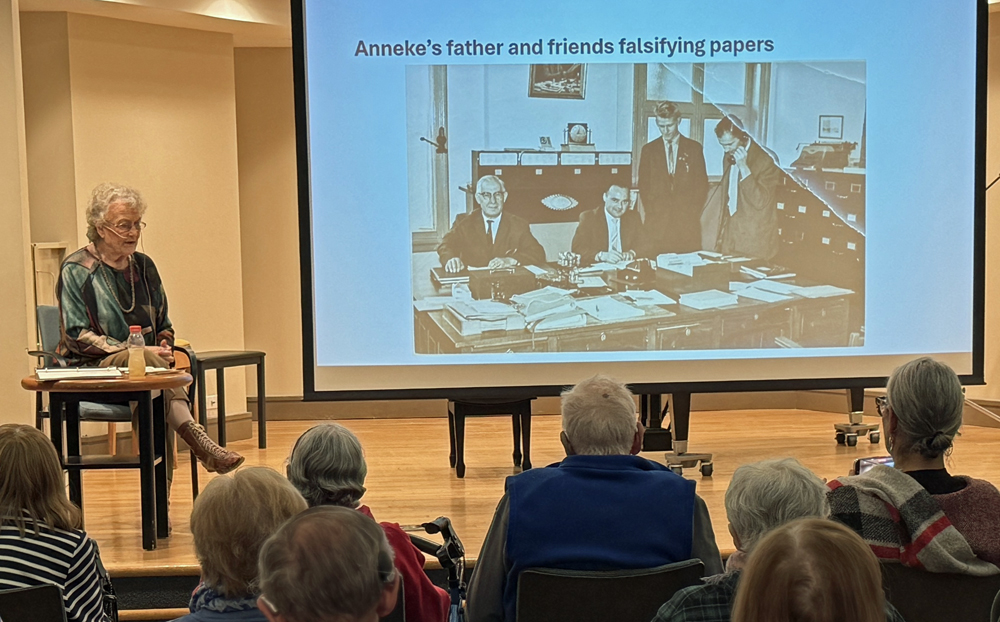
Anneke Tabachnikoff presents at Orchard Cove. (Hebrew SeniorLife photo)
By Michael Chmura
Canton resident Anneke Tabachnikoff shared memories of her childhood in Nazi-occupied Netherlands — and the quiet courage of her non-Jewish parents who helped Jews survive the Holocaust — during a recent program at Orchard Cove, a Hebrew SeniorLife community.
Speaking to more than 100 residents, Tabachnikoff recounted a childhood marked by war, secrecy, and loss, experiences she only fully understood years later.
“I didn’t know there was a rumbling going on in the Netherlands,” she said. “I was oblivious — until they built a bomb shelter in our garden.”
That shelter soon became essential. In 1940, Tabachnikoff was awakened by the sound of aerial combat overhead. Before entering the shelter, she saw planes burning in the sky.
“My father said the Germans had arrived,” she recalled. “I didn’t know who the Germans were or what that meant — only that we had to hide.”
Four days later, German forces bombed Rotterdam. From her town, Tabachnikoff could see the glow of the fires and hear the explosions. “That was the first time in my life I felt scared,” she said.
As the occupation deepened, everyday life changed. Windows were blacked out; schools were taken over by German soldiers; and Tabachnikoff was homeschooled for two years. When she eventually returned to school, she befriended a girl named Hilda.
“We were best friends,” Tabachnikoff said. “She had an accent and wasn’t from our town. For some reason, I was never allowed in her house.”
In late 1943, Hilda and other families disappeared. No explanation was given to the children. “Now I know,” Tabachnikoff said. “They were Jewish.”
Only later in life did Tabachnikoff learn the full extent of her parents’ actions during the war. Her father, Piet, worked at the town hall and was involved in the Dutch underground, a resistance network that helped Jews and others evade deportation.
“He did things I wasn’t supposed to know about,” she said, recalling men who came to the house for secret meetings and nights when her father was away more than usual. “He really risked his life, and I had no idea.”
She described being awakened one night by activity along the IJssel River. From her bedroom window, she saw people moving silently through the garden toward a barge. When she asked her father about it the next day, he told her they had been delivering bananas.
“I knew better later on,” she said.
After the war, Piet Tabachnikoff was awarded a medal by Prince Bernhard of the Netherlands for his resistance efforts. But the most personal revelation came years later, after a flood in 1953 required the carpet in their home to be removed.
Underneath was a hidden opening. When her father lifted it, she saw a ladder leading down, along with mattresses and hay.
“It was where he hid people,” she said.
The program was hosted by the Orchard Cove Shalom Club, which explores Jewish culture, history, and values through education and community programming. For attendees, Tabachnikoff’s story offered a powerful reminder that acts of rescue often occurred quietly — and that the responsibility of remembering and retelling these stories remains vital.
Short URL: https://www.thecantoncitizen.com/?p=133107


 Posted by