
Archaeology fieldwork gets underway at historic Gridley Cemetery
By Canton Citizen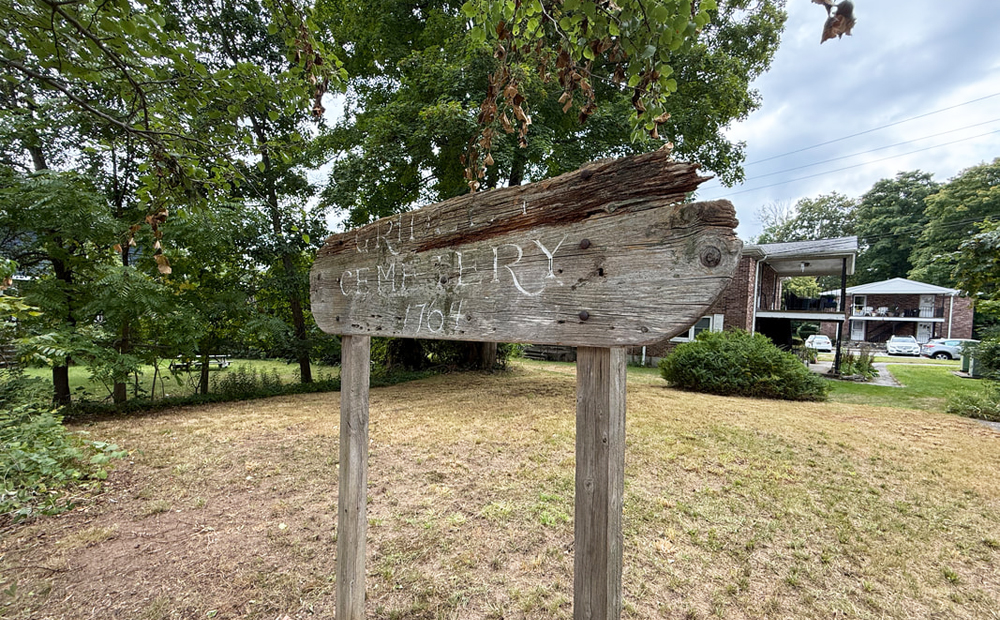
A weathered sign marks the site of the historic Gridley Burying Ground. (George T. Comeau photo)
What lies beneath one of Canton’s oldest and least-known historic sites? As part of Archaeology Month, the public is invited to see archaeological fieldwork in action on Saturday, October 10, from 11 a.m. to 2 p.m. at the historic Gridley Burying Ground, located near 13 Kinsley Place.
Faculty and graduate students from the Fiske Center for Archaeological Research at UMass Boston will be on site conducting experimental ground-penetrating radar (GPR) research as part of a multi-day investigation of the historic cemetery. GPR is a non-invasive technology that allows researchers to examine features beneath the ground without excavation or disturbance.
At the Gridley Burying Ground, researchers will use the technology to better understand the cemetery landscape, identify possible unmarked burials and other subsurface features, and gather information that can guide the site’s future preservation.
Throughout the public program, archaeologists will demonstrate the technology and explain how GPR is used in historical archaeology. Members of the Canton Historical Society will also be on hand to discuss the history of the site and the people associated with it.
Located off Washington Street near Shepard’s Pond, the Gridley Cemetery spans 2,304 square feet and represents an important surviving piece of Canton’s colonial landscape. Yet much of what is known about the cemetery has been lost to time. The site is marked by a weathered sign; however, there are no observable gravestones or markers, and the locations of the individual graves are largely unknown.
Created out of necessity after a smallpox outbreak swept across the area in 1764, the cemetery was originally opened as a family plot for the Leonard family and later became the resting place for Colonel Richard Gridley, the noted colonial military engineer whose long career included service during the French and Indian War and the opening days of the American Revolution. Gridley was the first chief engineer of the Continental Army and is considered the father of the U.S. Army Corps of Engineers. Canton’s former Gridley School, which remained in operation from the mid 19th century to the 1970s, was named in his honor.
While Col. Gridley’s remains were later relocated to Canton Corner Cemetery, several of his relatives are buried at the small burying ground that bears his name, including his son, Scarborough, his wife, Hannah, and possibly two of his daughters.
The research team from UMass Boston, led by Dr. John M. Steinberg, originally visited the site in late August to conduct a preliminary walk-through and test the use of GPR, and based on that assessment, the prospects for a successful investigation appear “quite strong,” according to the Canton Historical Society.
The researchers will seek to locate and map possible graves, estimate the number of burials within the cemetery, identify potential buried gravestones or other features, and provide a clearer understanding of how the cemetery was originally organized. Archaeological evidence may also reveal clues about where Col. Gridley was originally buried, although identifying a specific grave with certainty could prove difficult.
While excited about the work ahead, Historical Society President George Comeau cautioned that GPR cannot “magically provide names for every grave or answer every historical question.”
“Archaeology is rarely that cooperative,” he said. “What it can provide is evidence — patterns, anomalies, possible burial shafts, buried features, and a much clearer picture of how people used this small piece of land centuries ago.”
The research is being conducted in collaboration with the Canton Historical Commission as part of a broader preservation initiative for the cemetery. Testing will take place over several days and will help researchers assess the site and develop recommendations for its future protection and interpretation. Funding for this project is provided by the Community Preservation Act through the generosity of the citizens of Canton.
The October 10 program is open to the public. Visitors are encouraged to stop by anytime between 11 a.m. and 2 p.m. to see archaeological fieldwork underway, talk directly with archaeologists, learn about GPR technology, and discover an extraordinary piece of Canton’s early history.
Short URL: https://www.thecantoncitizen.com/?p=134774


 Posted by Canton Citizen
on Oct 2 2026. Filed under Features.
Both comments and pings are currently closed.
Posted by Canton Citizen
on Oct 2 2026. Filed under Features.
Both comments and pings are currently closed.