
Orchard Cove resident got our astronauts to the moon
By GuestBy Brad Cole
Twenty years before he bought his first computer at Radio Shack, Orchard Cove resident Ron Lang designed the technology that let NASA monitor astronauts on the moon, nearly 250,000 miles away.
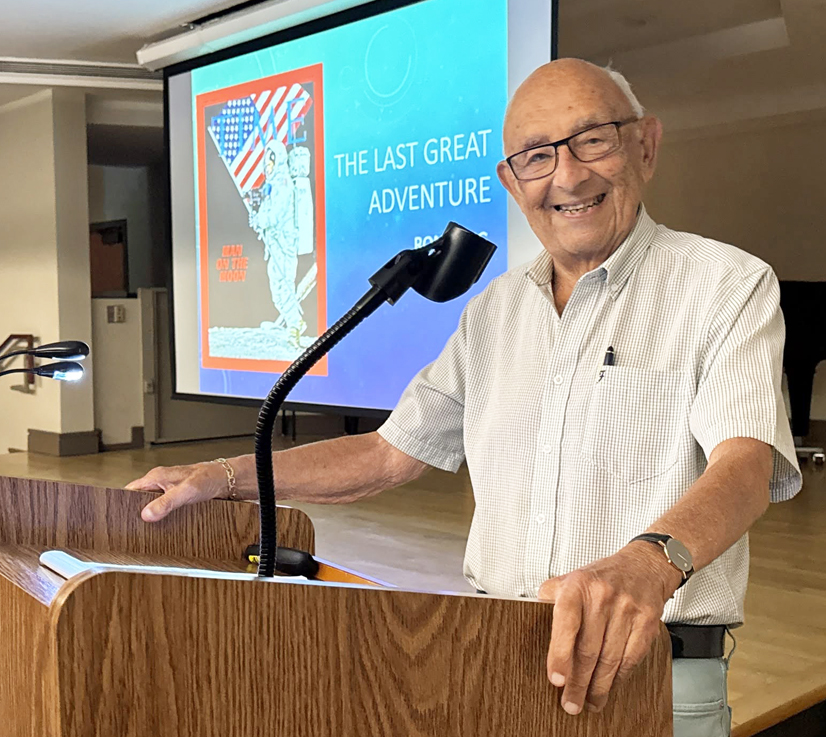
Ron Lang (Photo courtesy of Hebrew SeniorLife)
Lang recently shared his experience developing the Apollo Extravehicular Mobility Unit (EMU) and portable life support system (PLSS) — the space suit and backpack — during his years at Hamilton Standard in Windsor Locks, Connecticut.
“The Last Great Adventure” began in April 1961, when Soviet cosmonaut Yuri Gagarin orbited the Earth. President John F. Kennedy responded quickly, declaring in a May 1961 speech that the United States would reach the moon by the end of the decade.
“He didn’t have a clue. There was no way in the world that was a reasonable thing for [JFK] to say, but he was right,” Lang said, noting that NASA spent the next two years designing the system that would carry astronauts there.
Aeronautical engineer and MIT graduate Samuel Loring wrote the proposal that won Hamilton Standard the bid for both the EMU and PLSS during Thanksgiving week 1963. Loring passed away that same Thanksgiving.
“Just like that, Sam was gone. This guy who was our tutor, our boss, our mentor, and to this day, I hurt over it,” Lang said.
Lang was appointed interim chief engineer on both projects.
“I don’t know how to tell you this, but I was not the sharpest guy there,” Lang said. “I was not one of the MIT guys: I was from City College of New York, not that that was bad. It’s a very good engineering school, but I wasn’t the most qualified in my mind.
“I got the interim job knowing I would be replaced in the next four to six months. When we were about four months into it, NASA called the company and said, ‘We’re pretty pleased with this guy, Lang. Don’t replace him.’”
“They called me their New York Jewish tailor,” Lang said. “Each of their pressure suits was custom-built and had to be measured, and I was their Jewish tailor. I never told them I was Jewish, and you wouldn’t know from my name, but they knew!”
The engineering challenges were extraordinary. The suit needed a visor clear enough to see through in both total darkness and blinding sunlight, a way to deliver food and water and manage waste, and the durability to withstand a four-hour mission on the lunar surface, where temperatures reach 250 degrees Fahrenheit at one-sixth of Earth’s gravity.
Water posed its own problem. Carrying a single pint to the moon would take roughly 1,000 pounds of fuel, which meant astronauts simply could not sweat. Lang’s team built a long-underwear garment worn beneath the suit, threaded with about a mile of tubing. Circulating water held the body just below the 83-degree Fahrenheit point at which sweating begins.
“We tricked the body into not sweating by keeping it at 81 to 82 degrees,” Lang said.
The backpack did the rest: supplying breathing oxygen, storing a backup supply, scrubbing carbon dioxide and carbon monoxide, pulling moisture from the air stream, and venting heat into space. It weighed 90 pounds on Earth and a far more manageable 15 on the moon.
It also monitored heart rate, suit inlet pressure, and air temperature, along with the partial pressures of oxygen and carbon dioxide inside the helmet, oxygen tank pressure, skin temperature, deep body temperature, ECG, respiration rate, and battery voltage.
“It was amazing,” Lang said. “The guy is 250,000 miles away, and we’re monitoring their ECG, 65 years ago!”
Before any of it flew, the suit was tested in a vacuum chamber, a swimming pool, a zero-gravity environment, and on early flights in Earth orbit.
The suit was used by a variety of moonwalkers and missions, including by Neil Armstrong and Buzz Aldrin during the Apollo 11 mission in July 1969.
Short URL: https://www.thecantoncitizen.com/?p=134603


 Posted by