
True Tales from Canton’s Past: Brittle Pages
By George T. ComeauSince 1932, a simple, unassuming paper box has been tucked away in the vault at the Canton Historical Society. Inside this crude container rests one of the most invaluable treasures from our town’s very beginnings: The Parson Samuel Dunbar Diary. And today. as we’re preparing to celebrate the monumental 300th anniversary of Stoughton and the 250th anniversary of the United States of America, this incredible diary has completed a major, state-of-the-art conservation project. This book lets us dive into the past and explore the beautifully preserved pages that tell the tale of our people and events that shaped our community.
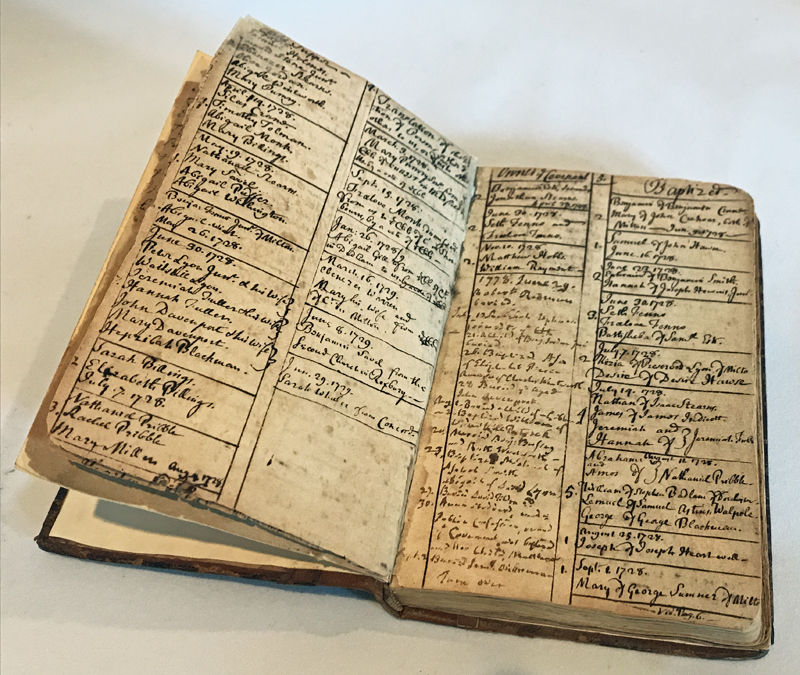
Samuel Dunbar’s diary with entries dated from 1727-75
Reverend Samuel Dunbar (1705-1783) was a towering figure in the community of Stoughton (now Canton), Massachusetts, serving as the minister of the First Parish Church for 56 years. Born around 1705, he was educated at the Boston Latin School and Harvard College under the guidance of the influential Puritan theologian Cotton Mather. By 1727, at the age of 23, he began his ministry in Stoughton, successfully restoring the congregation’s stability after the previous minister’s controversial departure.
Dunbar was widely regarded as the most highly educated man in early 18th-century Canton, fluent in Latin, Greek, and Hebrew. His ministry was vast and impactful, overseeing 1,703 baptisms, 690 marriages, and delivering over 9,000 sermons throughout his life. His life was marked by “solid character and steadfast rigidness,” yet he maintained an individuality of character into the autumn of his life that allowed him to evolve politically.
Initially devoted to both God and the Crown, he served as a chaplain for King George’s army during the conflict against the French in 1755. However, as colonial tensions rose, Dunbar aligned himself with the Patriot cause. His revolutionary commitment was cemented in 1774 when he attended the gathering of the Congress at the Doty Tavern at the foot of the Great Blue Hill in what is now Canton and delivered an “extraordinary liberty prayer.” This earned him the lasting nickname “The Son of Thunder.”
At the age of 71, in 1776, Dunbar delivered his 8,059th sermon, written in a personal code and “dripping with treason.” In this sermon, he used the biblical comparison of the Jews rising against their king to justify the colonists’ revolt against King George III, whom he denounced as a “true tyrant.”
This momentous sermon laid the groundwork such that the relationship between the colonies and the king was “totally dissolved.” He spent a half-hour absolving his fellow patriots’ consciences, granting them “license to be free” by asserting that it is “lawful for such people to withdraw their allegiance” when a king turns tyrant. This momentous day irrevocably cast the town toward revolution. Dunbar lived to see American freedom established, dying in Canton in 1783.
As in all things inside the Canton Historical Society, the small calfskin-bound diary is both fragile and precious. This is the original record of service to our community kept between the years 1727 and 1775 and written in Dunbar’s own hand. Donated by Francis Draper Dunbar in 1932, this is a crown jewel in the history of Dorchester, Stoughton, and Canton.
Earlier this year, the regional destination marketing group named Meet Boston offered a mini grant to celebrate the 250th anniversary of the American Revolution. The proposal to conserve this unique part of local and American history was granted over $6,500 to protect and digitize the Dunbar Diary. Turning to the Northeast Document Conservation Center (NEDCC), Jim Roache, curator of the Canton Historical Society, was tasked with delivering the book into the hands of some of the finest conservators in the nation. On a beautiful May morning, Roache boarded his RV motor home and promptly got lost on his epic voyage to Andover. For hours Roache gleefully traveled into New Hampshire, and by late afternoon had made his way to Andover with Dunbar’s diary.
The work that was done to this small book is pure science mixed with conservation art and will assure an extended life for this artifact. As Roache handed the box to the staff at NEDCC, they declared that this priceless artifact was in rough shape.
The original leather cover was very dry, dirty, and worn, with scuffed corners and visible, sticky residue from old adhesive cataloging tape. While the internal stitching remained strong, the pages themselves were fragile, dirty, stained, and splitting along ruled lines. After all, the oldest pages are close to 300 years old.
Crucially, earlier repairs to the oldest pages used stiff paper and glue that covered some of the original text and made the entire volume difficult to open. Furthermore, the sensitive brown ink contained iron gall, and since it was used throughout the diary, that ink prevented it from being safely cleaned with water. The book was also stored improperly in an acidic box that was too small and was causing further damage over time.
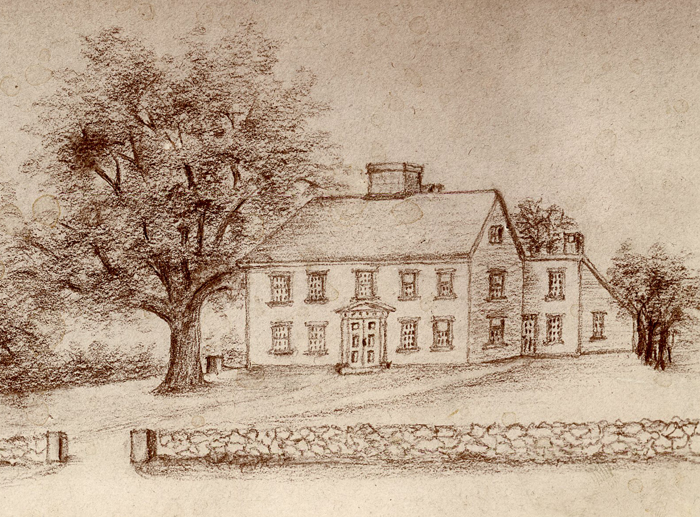
The home and parsonage of Rev. Samuel Dunbar, built in 1734 and demolished in 1884 (Collection of the Canton Historical Society)
Yet the five-month odyssey for the diary was affirming. For folks who wonder why these projects cost so much, the work that was done tells the story. Translated from the science to layman’s terms, what follows is an abbreviated description of the work.
The first step was a thorough but gentle cleaning. The conservators carefully took the book apart while keeping the original stitching intact. They vacuumed off mold spores and surface dirt. They then used specialized chemical solvents to safely remove the sticky residue left behind by the old pressure-sensitive tape. Since the paper was highly acidic and the iron ink was sensitive to water, the pages were treated with a special solution (including filtered water and alcohol) and chemicals to neutralize the acids, a process called deacidification. This chemical treatment was crucial for stopping the paper from degrading further. The pages were also “sized” with a thin coating to make the paper stronger and less prone to moisture damage.
The team then turned to repairs. The ravages of time and handling the book had taken a toll.
Tears, splits, and loose pages were meticulously mended using wheat starch paste and strong, thin Japanese paper. This method provides a reversible and supportive repair and will allow new science in the future to further analyze and preserve the book.
Once repaired, new handmade endsheets were added to allow the volume to open properly. The book block was resewn to stabilize the structure. The original cover was repaired and “re-backed” — meaning a new piece of high-quality calfskin leather was seamlessly attached to the spine to reinforce it. The corners were also strengthened, and 14-karat gold lettering was hand-tooled onto the spine to bring back the original title as it once looked on Dunbar’s desk.
The high-tech process included the use of state-of-the-art chemicals containing a dizzying list of ingredients. Products were used to de-acidify the paper. Cellulose and gelatin helped strengthen the pages. The finest Japanese Kozo paper and natural wheat starch paste mended tears. Linen cords were sewn in to strengthen the binding and support the original spine. New archival endsheets and boards were applied to further support the integrity of the volume.
After the conservation was complete, the entire volume was placed inside a custom-fitted, archival drop-spine box for maximum protection. The entire diary was also digitally photographed to archival standards, ensuring a permanent record exists without further handling.
This is a necessary and magical undertaking: safeguarding the legacy of a Founding Father whose work is a cornerstone of our nation. As Stoughton launches its 300th anniversary celebration, this book becomes our shared, living history. We are committed to ensuring that Parson Dunbar’s message of service rings true for the next 300 years. The book returns to Canton later this month. We are already planning a celebration of this man and our interwoven anniversaries in 2026.
Short URL: https://www.thecantoncitizen.com/?p=132699


 Posted by George T. Comeau
on Nov 7 2025. Filed under Canton History, Features.
Both comments and pings are currently closed.
Posted by George T. Comeau
on Nov 7 2025. Filed under Canton History, Features.
Both comments and pings are currently closed.