
True Tales from Canton’s Past: Courtship & Love
By George T. ComeauI’ve always said that one of the greatest joys is that of being a local historian. We get to be curious, nosey, armchair detectives. We get to go through dusty attics, open drawers, climb through ancient crypts, peak into long, lost hidey holes, and most of all, read other people’s mail!
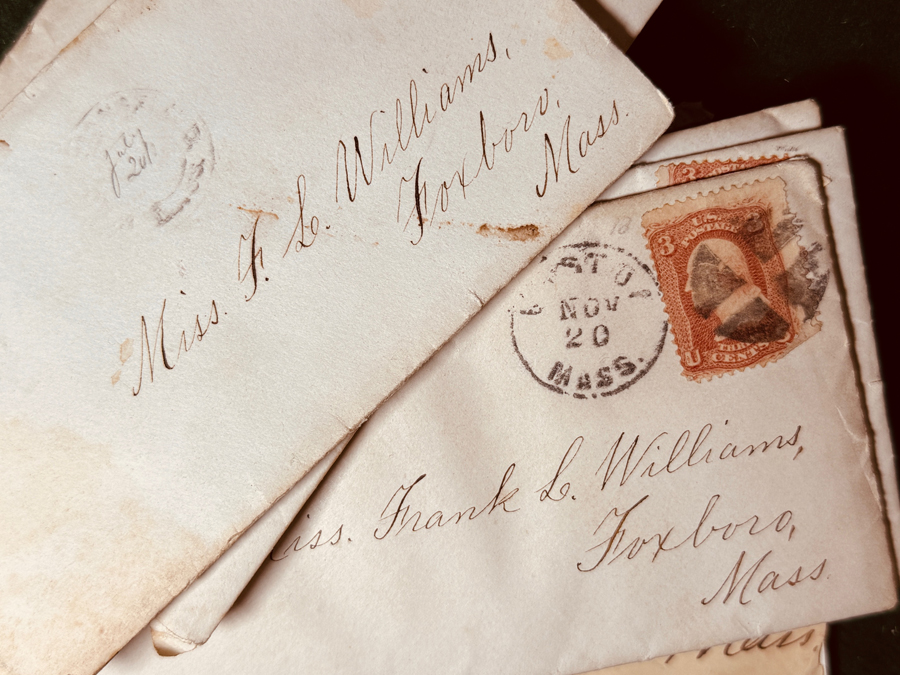 A small parcel of letters recently arrived at the Canton Historical Society. The letters were rescued by a fellow historian from Old Saybrook, Connecticut. The sheaf of “love letters” were on sale for $5, and this gentleman who purchased them wrote, “I, myself, am a historian, but my era covers the 1780s through the 18-aughts. That said, sometimes I feel a tug to collect something or other in an effort to keep it from winding up in a dustbin or left to rot, and then find an appropriate repository to give the item a home.” Written like a true historian — using words like sheaf, aughts, and repository. Such a brilliant act of kindness and passion for saving a piece of history.
The 13 letters were all neatly folded and in yellowing envelopes, dated between July 1868 and October 1870. They tell a story of a very private time in the life of a young man and woman who were in the early throes of courtship. They are the letters of Thomas Ellwood Grover to his soon-to-be fiancée, Frances Lydia Williams. They tell of an intimate story (for the mid-19th century) of courtship, romance, love, and passion across their pages.
Thomas Ellwood Grover was born in Mansfield in 1843. The Grover family was among the original settlers of Mansfield, and their name can be found in deeds dating to 1698. Grover’s father, also named Thomas, was a minister in the Society of Friends. Since father and son had the same name, the younger was known as Ellwood. The boy was educated in the common schools of Mansfield and attended the English and Classical Academy of Foxborough.
During the summer of 1867, at age 21, Ellwood journeyed to Ontario, Canada, with his father to attend Society of Friends’ meetings. In a letter home from Pickering, Ontario, we get the first glimpses of the politics of the younger Grover. Reflecting on the issue of voting rights, he notes, “I am writing this in Duffin’s Creek Hotel. I have just been talking with the landlord & he couldn’t see how those who have no property can have a right to vote, and take away the property from the wealthy. I asked him what right the wealthy have to vote and take away the liberty of the poor. He never thought of that. There is scarcely one who reads a paper and their papers don’t have the news — ’tis all politics.”
Ellwood then turns to the educational system in Ontario: “They have more schooling than we, yet there is not a passable reader. Little children 8 or 10 years old spend their time in learning Latin roots at the common schools. They never explain anything in arithmetic, and grammar is not taught to much extent, or geography either. How they can have so much school & learn so little I can’t see. At recess they are quiet. No one learns the use of that magic tool, the pocketknife. The school and everything are so bound by their laws, that all enterprise & aspiration is stifled as no one can hope to rise in the world.”
And finally, his gaze fell upon the people: “Their dress is coarse and they seem to have no taste. The women are not so good looking or so healthy as in the States. I should like to see a troop of our girls with their song & laughter here. The Canadians need something to wake them up.”
Later that same year, Ellwood studied law in Canton under Ellis Ames and was admitted to the bar in 1869. During that time, he met Frances Lydia Williams. The courtship began in the fall of 1867, and our collection of letters picks up in July 1868, where we begin to see his affection grow. “My dear friend,” he writes, “I should much rather see you than to attempt to write you a letter, or what I fear will prove only an apology for one; but as I cannot see you I gladly accept the next best thing, asking you not to expect anything brilliant or profound, if, indeed either of these belong to a friendly correspondence.”
Ellwood continues in a self-effacing tone, “I am ashamed of this of mine. It seems like a “mélange” of egotism and nonsense, and dull in proportion to its length.” And the letter signs off, simply, “Your friend, Ellwood.”
By September 1868, Ellwood addresses her as “my dear Frank” and signs his letter, “Faithfully yours.” Love is blooming. In that letter, Ellwood longs to be with Frankie. “I wish you were here, then I could read with you, and talk with you, and have a good time, as I always do when you are present.”
“Now, darling,” he continues, “don’t you think I have written quite a long letter? I write to you in perfect confidence, still I think much more than I say. I would surround every letter to you, with a garland of the brightest flowers, their color should be exquisite, their fragrance perpetual, with them I would twine the laurel, and surmount all with a wreath of myrtle. Would your dream be fulfilled? Hoping you will not forget, and with the best wishes I remain as ever faithfully yours.”
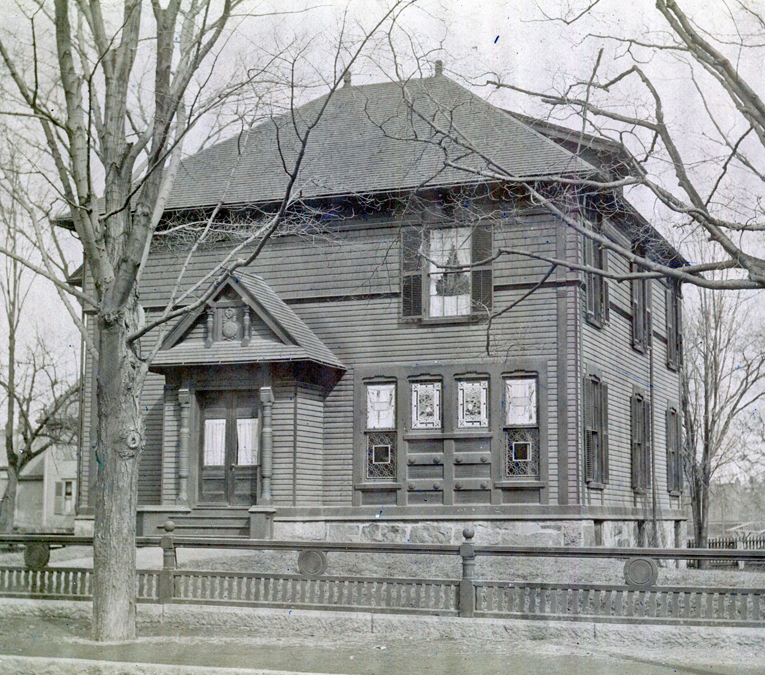
The Grover House, built for Thomas and Frances (Courtesy of the Canton Historical Society)
And by November of that same year, the letters are signed, “Your loving Ellwood.” The writing is starry and florid. “Well darling it is near the time when graveyards yawn … and I must stop.” He wishes to “reach a position more worthy” of her regard, and pines that his “desire overpowered” his intention. We do not have letters from Frankie to Ellwood, but he does compliment her in her replies. “I have been looking over your letters today; there are just 25, all charming, and more valuable to me than I can tell. Why should they not be? For they have made me happy as nothing else of the kind ever did, and some of them expressed the love of her who is all the world to me.”
In mid-1869, Ellwood is much closer to Frances and addresses her as “my own darling Frannie.” After being admitted to the bar, he opened an office in Boston and another in Canton. A letter in June 1870 hints at their upcoming marriage: “When the happy day arrives, that my dear little Franny is all my own, and when we live together all the time I shall watch my love so carefully and be so guarded against saying or doing anything to injure her feeling I know she will be happy and I shall too.”
In 1871, Thomas Ellwood Grover was admitted to the United States Circuit Court. Rising fast in his profession, he was made a trial justice in Norfolk County. Writing to his love, he talked of his work as a judge. “I have sent two men over to Dedham, and one woman,” notes Ellwood. “Most of the women tried before me are old hags, ugly at least if not old. This one is young and quite pretty, she is not much over 25 I should guess, is a mother of two children. If she gets bonds, she will stay out of jail awhile, if not she will have to labor after the county’s benefit. I had one young man up once and how pathetic his young wife was. She cried and told a pitiful story about her husband’s wrong. I suggested that it would look better if she had been married to him, and not his mistress. She stopped crying on that and said she didn’t care only he wanted her to try to get him off easy. He is serving out 90 days in the House of Corrections.”
The couple married on September 17, 1871, and moved to Canton. They built their life here and in 1879 built a magnificent home on Washington Street that still stands today. Ellwood was the consummate public servant. He became superintendent of schools, served on the School Committee, and was a member of the Canton Board of Water Commissioners. He became a state representative and shaped the legislation of modern railroads. He was a trustee of the Canton Institution for Savings and was well regarded in this community.
Thomas Ellwood Grover died in 1910 at the age of 67, and his darling wife lived quite well after his death. In 1921, Frannie traveled to San Francisco, and in 1928 she visited Honolulu, Hawaii. She became a music teacher and taught well into her 80s. On March 27, 1940, Frannie died at age 91.
These letters offer a beautiful, tangible glimpse into a four-year courtship, reminding us of the enduring preciousness of young love. We can now imagine the delight of that romance thanks to a fellow historian who ensured they were placed in the collection of the Canton Historical Society. Love, it seems, truly is a historical constant.
Short URL: https://www.thecantoncitizen.com/?p=132672


 Posted by George T. Comeau
on Oct 3 2025. Filed under Canton History, Features.
Both comments and pings are currently closed.
Posted by George T. Comeau
on Oct 3 2025. Filed under Canton History, Features.
Both comments and pings are currently closed.