
Canton man receives 2nd service dog
By Mary Ann Price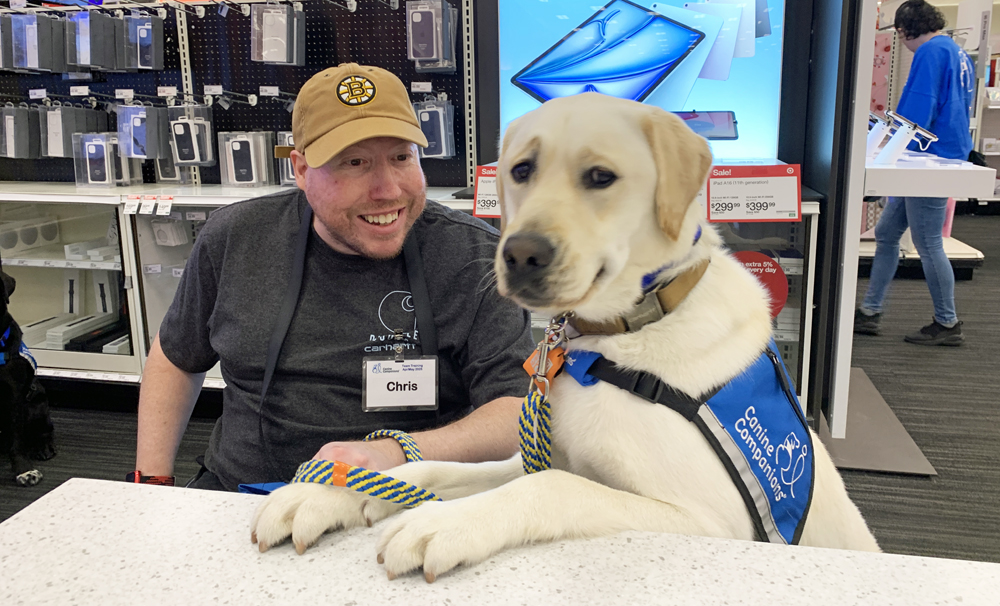
Chris McGarry with his new service dog, Bowen
Chris McGarry was born with spina bifida, a condition that happens in a developing embryo when the spine and spinal cord don’t form properly. As a result, McGarry has mobility challenges and requires the assistance of a wheelchair. Several years ago, he had balance problems and became concerned that leaning too far from the wheelchair to pick something up off the floor might make it difficult for him to get back up or cause him to fall over. That led to McGarry contacting Canine Companions, an organization that provides service dogs without cost to those who need them.
McGarry was born in Norwood and moved to Canton when he was 7. He is a 2005 graduate of Blue Hills Regional Technical School and has an Associate of Science degree from Mass. Bay Community College. He works at the Carhartt store at Legacy Place.
Due to his spina bifida, McGarry is paralyzed from the waist down. In 2014, he underwent a spinal fusion procedure and had a rod placed in his back to help address his scoliosis, which is a curvature of the spine. The rod straightened his back somewhat, but it limits his mobility and what he can do.
“That’s actually one of the reasons why I applied for a service dog — because I had a lot more limited mobility at the time,” he said.
McGarry met Twix, his first service dog, about eight years ago. Like other service dogs, Twix was trained to respond to about 40 commands. When McGarry said “Get,” for example, Twix picked up whatever was in front of him, and when McGarry said “Give,” Twix would hand the item over to him. He also gave things to other people when McGarry asked him to.
Twix picked up McGarry’s hats, keys, phone, writing utensils, and his own leash if McGarry dropped it while they were out for a walk. He carried things for McGarry, turned off light switches, pressed the access button to open doors of buildings, opened and closed drawers, and pulled baskets, among other tasks. He responded to “Drop,” “Bed” (jumping up onto a bed), “Lap” (putting his front paws on McGarry’s lap, and “Car” (jumping into a car).
“Under” is another useful command. If McGarry was on a bench, Twix would respond to “Under” by curling under the seat. “They’ll just lay down there,” he explained.
McGarry likes to travel and said it was helpful that Twix knew to get under a seat on a bus or a plane.
McGarry researched organizations prior to connecting with Canine Companions. “I knew I wanted a service dog, but I didn’t know a whole lot of companies in the area,” he said. He searched online and found that Canine Companions had a location in Long Island, New York. “Also, I picked them because they don’t require any payment for their dogs,” McGarry said.
Founded in California in 1975 to help adults, children, and veterans who have physical, cognitive or auditory disabilities, Canine Companions has training centers and field offices across the United States. McGarry said that training and raising a service dog can cost $50,000. Canine Companions is funded by private donations.
McGarry provided Canine Companions with paperwork from his doctor and information about himself, and then headed to their facility in Long Island for 10 days of training. “That way, you can learn not only the commands, but they judge what you can do, how well you can do things, and it puts you with the best dog that they think would work with you,” he said.
McGarry was part of a group of eight to 12 people and several trainers when he trained with Twix. “It’s actually a fun process,” he said.
Those who are seeking a service dog start by training with a carpet dog to learn the correct techniques and commands. Trainers then decide when the person should start working with a live dog.
“They’ll start you with a dog that’s in training,” he explained. “That way you won’t break a training that they’ve already done.” Training starts with easy commands and then progresses to more advanced tasks.
During the training session, McGarry worked with three or four dogs, and one of them was Trix, who seemed comfortable and was attentive to McGarry. “He wanted to work and he just liked being near me and my family,” McGarry said.
When the session ended 10 days later, Twix returned to Canton with McGarry, and he thrived in his new role as McGarry’s service dog. Around the time of the COVID pandemic, however, McGarry could see that he had started to slow down. Twix has since retired and now lives with McGarry and his new service dog, Bowen. Both dogs are a mix of Yellow Lab and Golden retriever, although Bowen is whiter in color than Twix. McGarry returned to Long Island for another 10 days of training before being matched with Bowen and returning to Canton in July.
“Bowen has a lot more energy than Twix did,” McGarry said. “He acts a lot more like a puppy.”
The two dogs get along well and both have gone to work with McGarry. Being with a service dog in public is different than being with a pet, and McGarry has had the experience of people approaching his dogs.
“I just ask them not to touch,” he said. “They can ask me if they can pet the dog.”
If he is in the middle of doing something, he will explain that it’s not a good time to interact with his dog. “It all depends on how busy I am,” he said.
McGarry said that one misconception about service dogs is that they don’t have a lot of personality, but each dog is different and has its own unique traits, he said. The dogs are trained well and are trained not to react to the people or situations around them. “But Bowen, once he’s got his vest off and he’s at home, he loves to run around the yard and play fetch,” he said.
Canine Companions instructor Robin Liberty, who trained Bowen, said it typically takes around two years to fully train a service dog. “After spending eight weeks with their breeder caretaker in Northern California, the puppies are flown around the country to their volunteer puppy raisers,” Liberty said. “The puppy raiser will be responsible for the puppy from age 8 weeks to 18 months. They teach them foundational skills and house manners as well as socializing them to all that they might experience as a future service dog.
“At around 15-18 months, the puppies return to one of our seven regional training centers across the country where a professional trainer like myself spends six to nine months polishing their basic skills, training specific service tasks, and evaluating their temperaments. The dogs are fully trained and ready for placement around 2 years old.”
***
September is National Service Dog Month. To learn more about the work that service dogs do and the people who train and support them, visit canine.org.
Short URL: https://www.thecantoncitizen.com/?p=132435


 Posted by Mary Ann Price
on Sep 26 2025. Filed under Features.
Both comments and pings are currently closed.
Posted by Mary Ann Price
on Sep 26 2025. Filed under Features.
Both comments and pings are currently closed.