
Canton True Tales: Vacation Photos
By George T. Comeau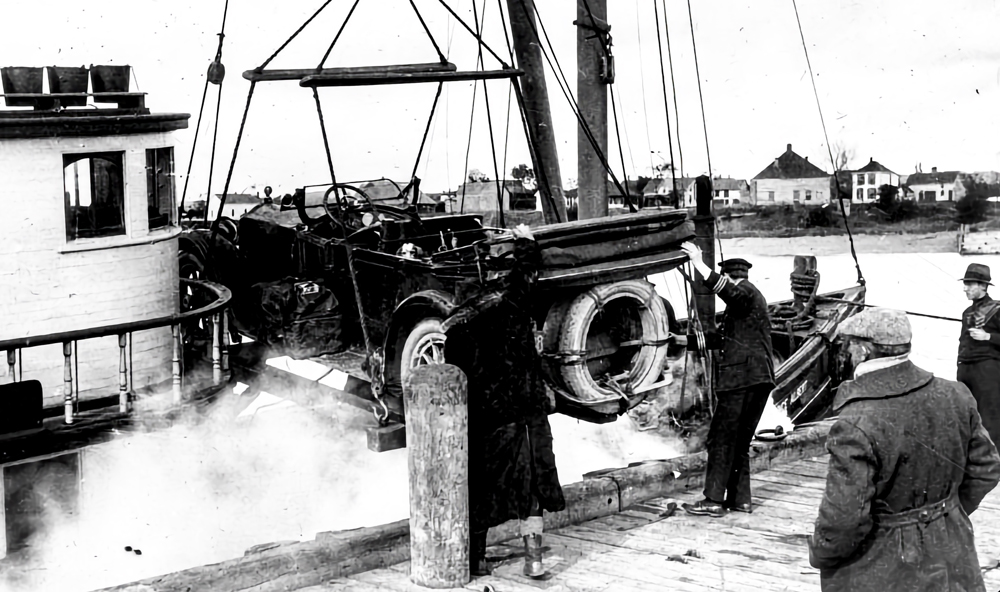
The 1919 trip to Nova Scotia, Canada, with the family car being loaded onto the deck of a small boat in Kingsport Harbor (Courtesy of the Canton Historical Society)
Benjamin Eames Morse was born at a time when photography was just starting to become mainstream. When combined with a thirst for travel and scientific curiosity, Morse had all the makings of a really great amateur photographer. More importantly, Morse and his brother Abner inherited a vast fortune that included income from patents and chemical processes that were built upon a worldwide licensing of their father’s invention of a common cleaning product found in modern households throughout the developed world. All of which centered upon their hometown of Canton.
Money was never an issue for the Morse Family. Elijah Adams Morse had invented a black paste stove polish in the mid 1800s, and the patents on that one product yielded millions of dollars in revenue that would sustain the family well into the late 20th century. The factory stood on Washington Street and is now a new condominium development. A small park at the site today tells the story of the worldwide impact of the product and the revenue stream derived from the black graphite and lead paste.
In addition to the income resulting from the Rising Sun Stove Polish Company, the Morse Brothers also licensed and produced pay toilets as part of their ownership of the Aseptic Services Company. Aseptic produced special hygienic toilets for hotels and hospitals that ensured “an individual paper covered toilet seat” for every user. The company also produced coin-operated bathrooms that were serviced directly by the company, guaranteeing income streams after the sale of the products.
With stream of income virtually assured for life, the young men set their sights on travel. And, travel they did. In the summer of 1912, Ben and Abner Morse traveled to France with their chauffer from Canton by the name of Richard Briggs. In a twist of historic coincidences, this story is being written inside the house that Briggs purchased from the Morse Family on Sherman Street.
In the spring of 1913, the duo spent time on a grand trip to Europe and a side excursion to Egypt. Along the way they purchased glass lantern slides and they carried a camera capable of taking 5×7 photographs. Hundreds of photos from that trip have survived and are now over 113 years old and preserved at the Canton Historical Society. The photos show the brothers at the foot of the Sphinx in Egypt, riding camels and donkeys, feeding pigeons in St. Mark’s Square in Venice, at temples in Sicily, and alongside Zeppelin airships in Germany. Months of travel yielded hundreds of photographs.
In order to be a photographer in the early 1900s meant that you needed money, equipment, and a working knowledge of the chemical process that would lead to developing photographs. Ben Morse had all three attributes. Ben attended the Massachusetts Institute of Technology and began his career as a bookkeeper at his father’s factory.
By the time Ben was in his early 20s, he began exploring the world beyond Canton. During his explorations, he took his camera, and sometimes his brother and local friends would accompany him. What the Morse Brothers left behind is a fantastic photo record of travel in early 20th century. Hundreds of glass plate negatives and lantern slides were carefully stored in wooden boxes in their home.
Of great historical significance are the photos taken in 1912 as part of a grand voyage aboard the S.S. Sixaola between New York and the Panama Canal. This trip was taken while the canal was under construction and was a pleasure cruise aboard a new steamship owned by the United Fruit Company. This tropical fruit ship carried both passengers and bananas and coined the phrase “banana boat.”
Leaving New York City on Saturday, April 6, 1912, the 43 passengers would travel together for 24 days and make extended trips to Kingston-Colon (Panama Canal), Bocas Del. Toro, Limon, and Costa Rica. The refrigerated ship had all the modern amenities of the time. Ben carried his camera and his 72 surviving photos show the construction of the canal as well as the cities they visited along the way. To add to the visual collection, close to 150 postcards were purchased and are part of the memories from the trip.
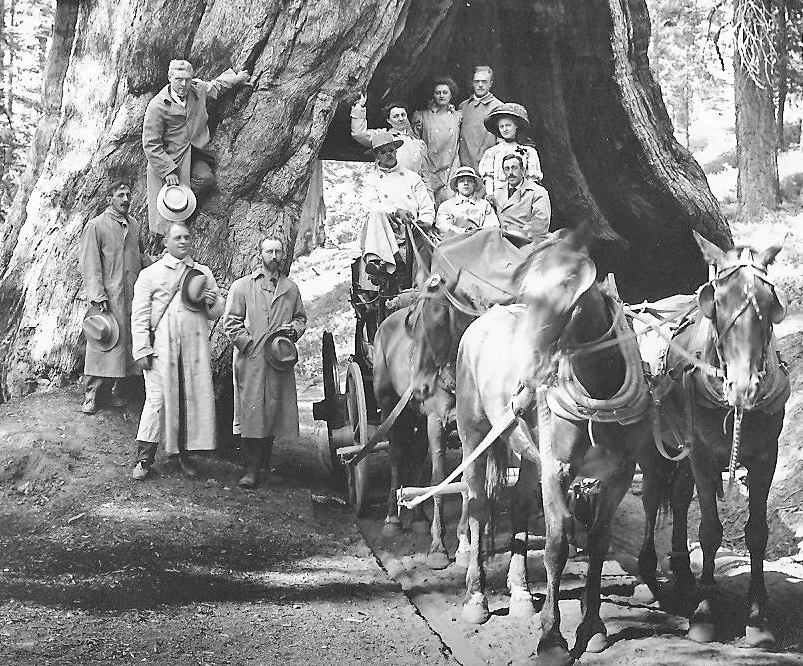
“Through the Redwood Forest” in 1915. Ben Morse is climbing the side of the tree on the left of the photo. (Courtesy of the Canton Historical Society)
In 1915, there was a trip to San Francisco, and we see the Morse Family driving through the iconic Redwood Forest. Extensive photos from the World’s Fair are wonderful to see. Some of these photographs were damaged in a fire at the Morse Estate in the mid 20th century. There are also dozens of glass slides showing the wholesale clear cutting of Northern Maine to feed the hunger for the paper mills. Ben Morse made what would be dozens of trips to witness the felling of forests in what today is Baxter State Park. Before the land for the park was acquired in 1931, much of the area had already been logged. This included extensive clear-cutting, a practice that left the landscape devastated. Morse created a great record of the destruction.
There are also trips closer to home. In 1919 there was a vacation to Nova Scotia, and the glass slides from that trip show the birth of the Canadian maritime travel industry. The trip included driving through New Brunswick and the family car being loaded onto the deck of a small boat to cross the Minas Basin into what is now Grand-Pre. The trip also documents a visit to Fort Anne two years after the fort at Annapolis Royal became Canada’s first administered national historic site.
Today, Jim Roache is processing a collection that whispers of a bygone era. He’s curating a treasure trove of hundreds of slides, prints, and postcards — the tangible remnants of a world once seen through the eyes of the Morse family here in Canton. This sprawling collection arrived at the Canton Historical Society in quiet batches, and for years, these memories sat patiently on a shelf, waiting for a chance to live again.
With a tender touch, Jim now gives each image the care it deserves. Every glass slide is meticulously cleaned, stabilized, and scanned, then gently tucked away in archival folders and acid-free boxes. It’s a labor of love that has taken years, a delicate dance with time itself. These images have weathered the tests of a fire, water, and the slow passage of decades, making their preservation a sacred trust.
The collection speaks of the thrill of travel at a time when such journeys were an unattainable dream for most. The photos reveal not just grand vistas but also the quiet moments of daily life in distant lands. One can almost feel the hush of a late-night gathering in Canton, as the images flickered on a screen, each one a window to a place beyond the familiar horizon of the Great Blue Hill. These aren’t just pictures; they’re the echoes of dreams and the lingering spirit of adventure.
Short URL: https://www.thecantoncitizen.com/?p=132336


 Posted by George T. Comeau
on Sep 19 2025. Filed under Canton History, Featured Content.
Both comments and pings are currently closed.
Posted by George T. Comeau
on Sep 19 2025. Filed under Canton History, Featured Content.
Both comments and pings are currently closed.